Digital Marketing Hiring & Salary Trends: What to Expect in 2027
Excerpt from Addison Group’s 2027 WORKFORCE PLANNING & SALARY GUIDE
Key Takeaways
- Demand for AI-ready marketers will surge, with a projected 6% growth in marketing manager jobs by 2034.
- AI skills have become essential, as candidates must now demonstrate how they’ve used AI to achieve business results.
- New marketing fields like Generative Engine Optimization (GEO) and Answer Engine Optimization (AEO) are emerging, reshaping SEO jobs.
- Employers are shifting to skills-based hiring, prioritizing candidates’ capabilities over traditional qualifications.
- In this fast-changing landscape, marketers who combine AI proficiency with traditional skills will be in high demand.
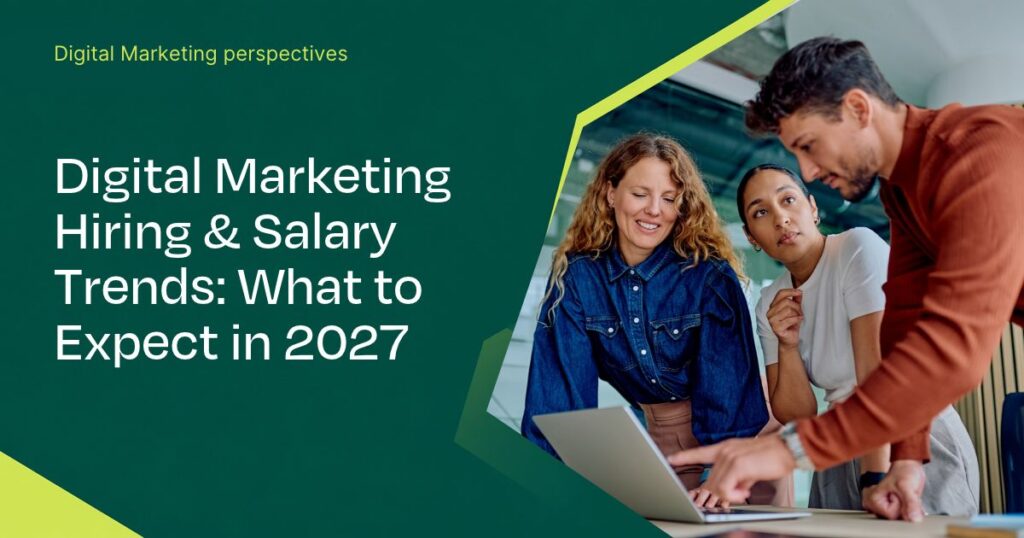
Digital Marketing Hiring & Salary Trends: What to Expect in 2027
Demand Skyrocketing for AI-Ready Marketers
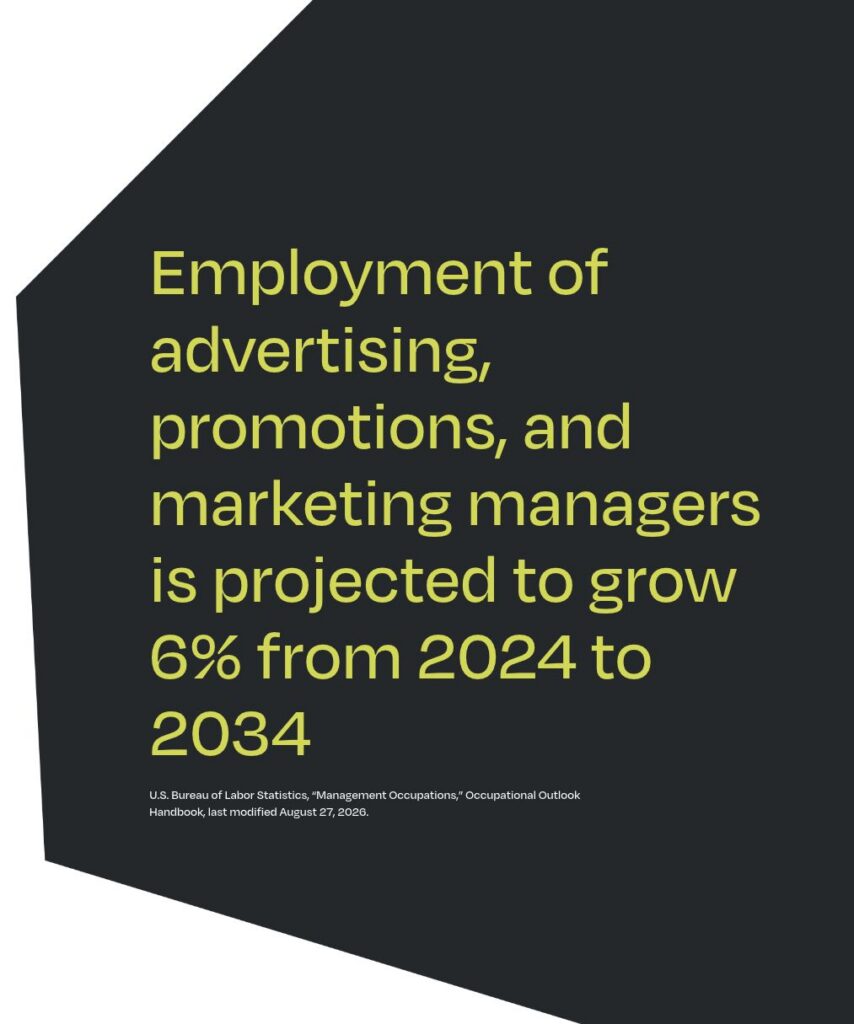
Employment of advertising, promotions, and marketing managers is projected to grow 6% from 2024 to 2034 — faster than the average for all occupations — with about 36,400 openings projected each year, largely driven by digital and online advertising growth.1
The biggest shift in digital marketing hiring may be the rapid rise in demand for AI skills. As of June 2026, the share of marketing job postings requiring AI literacy has more than doubled year over year, increasing 113%.2 Experience using AI is increasingly moving from a “nice-to-have” qualification to a baseline expectation, particularly for candidates working in content, analytics and marketing automation.
For candidates, simply saying they have AI experience may no longer be enough. Today, traditional marketing fundamentals pair with AI fluency, analytical thinking and the ability to translate technology into business results. Top talent will be able to demonstrate they’ve used AI to automate workflows, analyze data or drive measurable business results. In some cases, demonstrated AI proficiency carries the same weight as an advanced degree.3
Not only is AI changing the skills marketers need, but it’s also changing how consumers search for information, creating an entirely new layer of expertise for digital marketing teams.
AI Search Reshaping SEO Jobs
Search itself is changing shape, and so is the job of optimizing for it. Nearly a third of the U.S. population will use generative AI search in 2026, and employers are responding.
The result is an entirely new marketing discipline alongside traditional Search Engine Optimization (SEO). Generative Engine Optimization (GEO) and Answer Engine Optimization (AEO) focus on getting a brand mentioned, cited, or recommended inside an AI-generated answer rather than ranked in a list of links through a traditional search engine like Google. This shift is only expected to intensify in the coming year. 94% of CMOs plan to increase AEO/GEO investment in 2026, having allocated an average of 12% of digital budget to it in 2025.4 The investment suggests this is moving quickly from an experimental tactic to an established marketing function.
For candidates, this is a rare green-field opportunity: a title that barely existed two years ago, real budget behind it from employers, and still relatively little competition. As this marketing specialization continues to emerge, digital marketers who move first to build structured data and AI-citation tracking into their skill sets will be highly sought after. A recent industry report highlighted that candidates who bring AI experience are already gaining faster promotions and earning a higher salary, with that gap expected to widen.5
As the tools and channels change this quickly, Addison Group has found that employers are also rethinking how they define and evaluate qualified marketing talent.
Results over Resumes
It’s clear that the four-year degree is losing its grip on marketing hiring, and new marketing technology is accelerating the shift rather than slowing it down. Employers are increasingly focusing on what a candidate can do rather than where they went to school or what their previous job title was. 70% of employers now use skills-based hiring, up from 65% the year before, and 71% of those employers apply it at least half the time.6
As AI takes over more of the routine execution, the roles left for humans increasingly demand judgment, adaptability, and problem-solving. That shift is changing what employers look for in digital marketing candidates. Technical proficiency still matters, but employers increasingly need marketers who can leverage tools and apply them strategically.
For candidates, a certificate or a job title tells an employer less than it used to. A portfolio that shows a GEO campaign that earned real AI citations, or a demonstration of how they increased conversion rates, will outweigh a credential every time. For employers, the payoff is a wider funnel of potential candidates, but only for the ones willing to build a real skills assessment into the process rather than just dropping the degree line from the job post. Moving forward, the challenge will be to identify and screen candidates who understand the difference between simply experimenting with AI and developing a repeatable strategy around it.
Related content
- Hiring Marketing Talent in the Age of AI
- The Importance of Employer Branding in a Competitive Digital Marketing Talent Market
- 3 Things You May Have Missed in Succession Planning
“We’re not asking candidates if they’ve used AI anymore because everyone says yes. We’re asking them to show us the workflow they automated or the campaign it improved. That’s the new bar.” – Mike Weast, President, IT and Digital Marketing, Addison Group
Top Digital Marketing Salaries
| e-Commerce Director | $169,730 |
| User Experience (UX) Designer | $119,494 |
| Business Intelligence Analyst | $119,048 |
| Digital Marketing Manager | $113,371 |
| User Interface (UI) Designer | $109,059 |
| Web Developer | $107,233 |
| Technical Writer | $100,772 |
| Content Manager | $90,398 |
| Digital Marketing Analyst | $90,297 |
| Social Media Manager | $86,180 |
Contact us today to optimize your workforce strategy and secure the skilled talent your business needs.
For more valuable insights and national averages of salaries across hundreds of roles in administrative, digital marketing, finance, accounting, healthcare, human resources, and information technology, download your complimentary copy today.
- https://www.bls.gov/ooh/management/
- https://www.linkedin.com/pulse/adobe-x-linkedin-announce-new-initiative-uplevel-lqp3e/
- Addison Group, (Mike Weast, President IT & Digital Marketing) 2026
- https://www.conductor.com/academy/state-of-aeo-geo-report/
- https://www.gsdcouncil.org/blogs/future-ready-ai-skills-for-professionals
- https://naceweb.org/job-market/trends-and-predictions/employer-use-of-skills-based-hiring-practices-grows
FAQ
AI is now part of core digital marketing work, including content, analytics, automation, workflow optimization and campaign measurement. Because job posts requiring AI literacy have more than doubled year over year, candidates are increasingly expected to show not just experience with AI tools, but proof that they used them to improve business results.
Traditional SEO focuses on helping a brand rank in search engine results pages, usually as a list of links. GEO and AEO focus on getting a brand mentioned, cited or recommended inside AI-generated answers. As generative AI search grows, employers are putting more money into these newer fields so their brands stay visible in AI-driven search tools.
Candidates should include proof of measurable results, such as workflows they automated, campaigns improved with AI, conversion-rate gains, data analysis examples, structured data work or GEO campaigns that earned AI citations. The key is to show applied skill and a repeatable strategy, not just tools or credentials.
Marketing technology is changing quickly, and a degree or job title may not fully show whether a candidate can solve current business problems. Employers are increasingly favoring demonstrated ability, flexibility, strategic thinking and technical fluency, especially as AI takes over more routine work.
The text highlights Digital Marketing Manager, SEO/AEO/GEO Specialist, Marketing Strategist, AI/Automation Strategist and Performance Marketing Specialist as in-demand roles. These jobs reflect the growing need for marketers who can combine traditional judgment with AI fluency, search change and measurable results.