Future of Healthcare: 2027 Hiring & Salary Trends
Excerpt from Addison Group’s 2027 WORKFORCE PLANNING & SALARY GUIDE
Key Takeaways
- Healthcare teams face operational backlogs due to high workloads and staffing shortages, increasing the demand for revenue cycle management roles.
- AI cannot replace complex revenue cycle work; instead, it augments admin teams, emphasizing the need for human judgment in denials management.
- Healthcare IT support is vital for maintaining and optimizing systems, projected to grow 15% by 2034 due to EMR adoption and compliance needs.
- Candidates blending revenue cycle knowledge with technical skills will command higher salaries, as employers seek expertise in automation and data analytics.
- To attract top talent, employers must streamline hiring processes and offer competitive compensation, highlighting the importance of flexibility and skill relevance.
Future of Healthcare: 2027 Hiring & Salary Trends
The Backlog Behind the Hiring Surge
Non-clinical healthcare teams are under growing pressure, contending with operational backlogs driven by high workloads, persistent staffing shortages, and increasingly complex reimbursement requirements.
Revenue cycle management roles are among the most in-demand positions as providers navigate rising claim denials, increasing patient financial responsibility, and the complexities of high-deductible health plans. With healthcare costs projected to rise 9% in 2027,1 providers are placing an even greater emphasis on protecting reimbursement and improving financial performance.
The administrative burden is significant: the American Hospital Association estimates that hospitals spent $43 billion in 2025 trying to collect payments insurers owed for care already delivered, with claims denials, prior authorization, repeated documentation requests, and evolving billing and coverage rules contributing to the cost.2 This will only increase the need for experienced revenue cycle professionals. Hospitals and medical groups in specialties such as orthopedics, dermatology, and ophthalmology are also seeking coding auditors and medical billing specialists to help manage their growing billing and collections volume.
“Healthcare organizations that realized early that AI would augment instead of replace revenue cycle expertise are in a much stronger position today, and we anticipate that trend will continue in 2027.” Kelly Gorham, President, Healthcare Division, Addison Group.”
AI Augments, People Deliver
With demand for experienced talent outpacing supply, many organizations have looked to automation to close the gap, but AI’s track record on the most complex revenue cycle work tells a more complicated story. Despite more than $100 billion invested in digital and automation platforms since 2010 3, AI has yet to replace the expertise required for complex revenue cycle work. Instead, organizations are increasingly using AI to augment administrative teams rather than replace them. Even where automation exists, as AI tools lack the critical thinking required for denials management and payer interactions. Insurers have grown wise to patterns in automated claim submissions, pushing denials and appeals backlogs to record levels.4
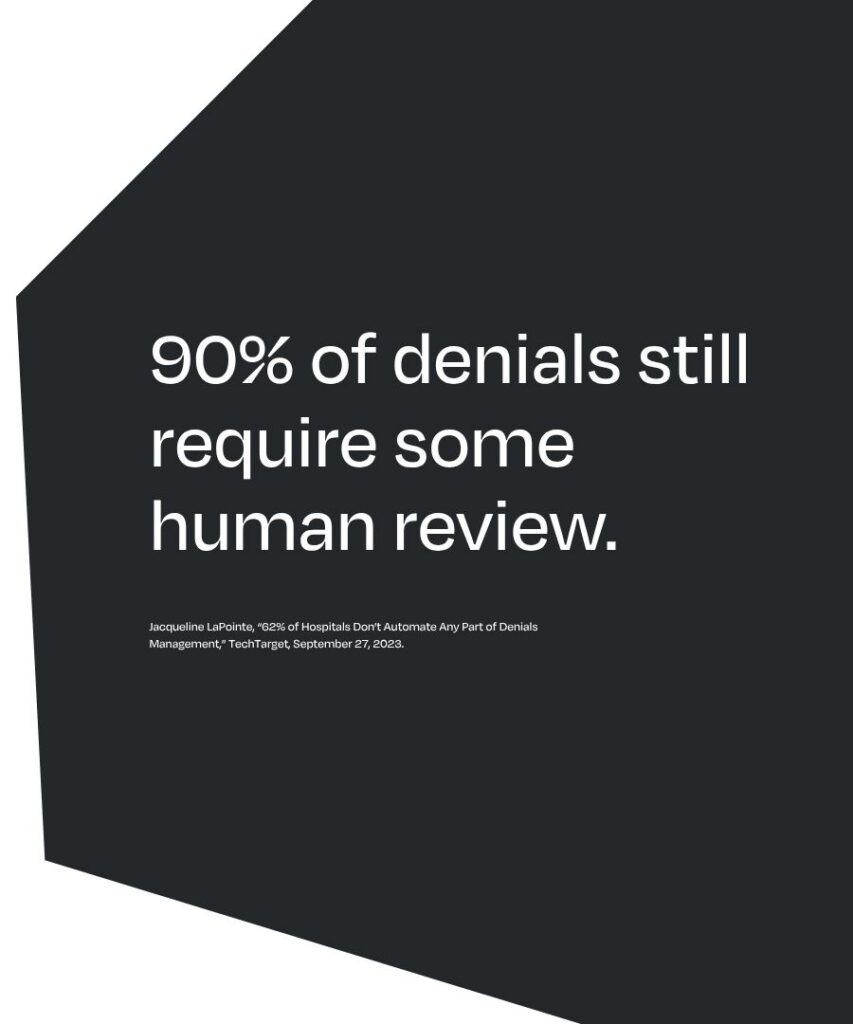
Healthcare systems continue to take a measured approach to AI: 62% still don’t automate any part of denials management, and where automation exists, 90% of denials still require some human review.5 Because most denials still require human judgment, organizations that rely too heavily on automation risk missing reimbursement opportunities and a poorer patient financial experience.
Healthcare IT Support Growing
AI integration into clinical and financial systems is fueling a parallel need: the IT professionals who keep it all running. Rising adoption of electronic medical records (EMR), along with growing compliance needs and AI integration, is projected to drive 15% growth in healthcare IT jobs through 2034.6 Organizations need IT professionals who can translate data into positive financial outcomes. These experts are needed not only for system implementation but also for ongoing optimization to ensure a clean claims process, accurate documentation, and coding quality. Specialties such as revenue cycle systems optimization, CDI & HIM technology support, clinical data & financial analytics, and interoperability and integration support organizations at the intersection of clinical systems, coding workflows, and financial performance.
Related content
- How to Build a Non-Clinical Healthcare Career Path
- Non-Clinical Healthcare Hiring Trends: Revenue Cycle, Patient Access, and Operations
- Skills-Based Hiring in Healthcare: What it is, Why it Works, and Top Skills to Prioritize
The Real Upper Hand
The demand for specialized skills is also changing who holds the leverage. Addison Group has found that both employers and candidates seem convinced they hold the upper hand in negotiations, but the reality is more nuanced. For job seekers, compensation remains the top priority, driven largely by the rising cost of living, with flexibility a close second. Remote positions are still available for many non-clinical roles, but they’re highly competitive, often drawing hundreds of applicants per opening with employers increasingly filtering for candidates strong in automation and data-driven decision-making.
As AI narrows the gap on routine tasks but continues to fall short on judgment-driven work like denials management, professionals who can bridge technical fluency and revenue cycle expertise are commanding a premium.
The premium is already showing up in the numbers: modest salary increases of 3.5% are projected for entry to mid-level non-clinical positions, but senior candidates with experience in process automation, AI, data analytics, and predictive modeling can earn well above that. The candidates commanding higher salaries aren’t necessarily the ones with the most AI experience on paper but rather the ones who can apply the judgment AI can’t: catching a denial pattern automation missed or knowing when a system’s flag needs a human override. That combination, not AI exposure alone, is what employers should be screening for.
That same urgency is reshaping how fast organizations need to hire. The question for healthcare organizations isn’t just what to pay for this talent; it’s whether their talent acquisition process, often split across contract, interim, and permanent, can move fast enough to secure it before a competitor does.
“Healthcare administrative leadership hires have shifted from strategic investments to operational necessities. Top talent is often secured within three to five weeks, rewarding organizations that move decisively.” – Lauren Badonski, Sr. Vice President, Healthcare, Addison Group.
Top Healthcare Salaries
| VP of Revenue Cycle Management | $175,000 |
| Rev Cycle IT Project Manager | $149,760 |
| Revenue Cycle Director | $148,682 |
| EHR Implementation/Optimization PM | $145,600 |
| Principal/Trainer (EHR) | $141,440 |
| Certified App Analyst – Willow/Beaker/OpTime | $141,440 |
| Inpatient Services Director | $141,214 |
| Operations Director | $140,369 |
| Rev Cycle App Analyst (Resolute HB/PB) | $135,200 |
| Certified App Analyst (Ambulatory/Inpatient) | $135,200 |
Contact us today to optimize your workforce strategy and secure the skilled talent your business needs.
For more valuable insights and national averages of salaries across hundreds of roles in administrative, digital marketing, finance, accounting, healthcare, human resources, and information technology, download your complimentary copy today.
- PwC Health Research Institute, “Medical cost trend 2027: Behind the Numbers,” projecting a 9% commercial group medical cost trend for 2027 — the highest in 17 years. https://www.pwc.com/us/en/industries/health-industries/library/behind-the-numbers.html
- American Hospital Association (AHA), Costs of Caring: Challenges Facing America’s Hospitals as They Care for Patients in 2026. https://www.aha.org/costofcaring
- https://www.weforum.org/stories/health-and-healthcare-systems/digital-solutions-and-ai-in-healthcare/
- Aptarro, “50+ US Healthcare Denial Rates & Reimbursement Statistics for 2026,” https://www.aptarro.com/insights/us-healthcare-denial-rates-reimbursement-statistics
- TechTarget, “62% of Hospitals Don’t Automate Any Part of Denials Management,” citing Experian Health’s 2025 State of Claims report. https://www.techtarget.com/revcyclemanagement/news/366600320/62-of-Hospitals-Dont-Automate-Any-Part-of-Denials-Management
- https://www.bls.gov/ooh/healthcare/health-information-technologists-and-medical-registrars.htm
FAQ
Providers face more claim denials, more patient cost share, more high-deductible plans, and more complex pay rules. With healthcare costs set to rise 9% in 2027 and hospitals already spending billions to collect insurer payments, teams need skilled revenue cycle staff to protect reimbursement, cut backlogs, and improve financial results.
Not for the hardest revenue cycle work. AI is being used to augment admin teams, not replace them, because denials management, payer work, and appeals still need human judgment. Even where automation exists, most denials still need human review.
The strongest candidates combine revenue cycle know-how with tech fluency. Employers value process automation, AI, data analytics, and predictive modeling, but the real edge is the ability to use human judgment on hard problems, like spotting a denial pattern automation missed or deciding when to override a system flag.
As healthcare groups add more EMR systems, bring AI into clinical and finance work, and face more compliance demands, they need IT pros who can keep systems running and make them better. These roles help with clean claims, accurate documentation, coding quality, system links, analytics, and stronger financial results.
Employers need to move fast and with purpose. Top talent is often secured within three to five weeks, so slow or split-up hiring processes can lose strong candidates to rivals. Good pay, flexibility, and a clear view of the skills that matter most can help employers stand out.