Shifting Dynamics in Administrative Hiring & Salaries 2027

Excerpt from Addison Group’s 2027 WORKFORCE PLANNING & SALARY GUIDE
Key Takeaways
- Administrative roles are evolving, not disappearing, with jobs remaining stable through 2034 despite automation.
- Candidates with AI skills will earn a premium, emphasizing the demand for communication, judgment, and relationship-building abilities.
- AI enhances efficiency by automating routine tasks in customer service, enabling professionals to focus on strategic roles.
- Employers are streamlining hiring processes, reducing time-to-hire for admin roles to attract top talent in a competitive market.
- In-demand positions for 2027 include executive assistants, HR assistants, and customer service specialists.
Shifting Dynamics in Administrative Hiring & Salaries 2027
Admin Roles Evolve, Not Disappear
Every hiring cycle brings a new round of speculation about which jobs AI will replace first, and administrative and customer service roles are almost always near the top of the list. The reality on the ground looks different: these roles are shifting rather than disappearing, expanding in scope, becoming more strategic and increasingly tied to a candidate’s comfort with AI tools.
Administrative roles will remain relatively flat through 2034, but openings will persist across industries, driven mainly by workers leaving the occupation or retiring.1 Some entry-level data jobs will go away, but they’ll be replaced by roles where human insight remains critical.2
In-demand roles for 2027 include executive assistants, administrative assistants, HR assistants, and customer service specialists – and candidates who bring AI skills to any of them will earn a premium.3
The Human Edge Holds
Artificial intelligence is changing the way businesses operate, but its impact on administrative and customer service positions is more nuanced than just simply replacing people with technology.
Across both functions, AI is increasingly used to automate repetitive tasks, improve efficiency, and help employees manage higher volumes of work. Employers place a growing value on the skills that AI can’t replicate: communication, judgment, problem-solving, relationship-building, and the ability to manage complex situations.
A recent survey found that only 20% of organizations had reduced headcount due to AI deployment while 55% reported stable staffing levels even as they handled higher customer volumes.4 The same survey found 84% of organizations plan to add new skills to frontline roles, and nearly 80% plan to shift agents into newly created positions.5 AI is currently functioning primarily as an efficiency multiplier rather than a wholesale replacement for many admin roles – in other words, they are being redesigned around AI, not eliminated by it.
That creates real opportunity for professionals who lean into AI early. Customer service specialists who train on tools such as Freshdesk and Help Scout are positioning themselves ahead of the curve. Employers should remember that candidates don’t need to be AI experts, but they should be comfortable learning and applying tools like Claude, ChatGPT and Microsoft Copilot.
“Companies that don’t have a repeatable process and are not moving candidates through the interview-to-hire process as quickly as others are losing out on top talent in a competitive hiring landscape.” – Ed Kavanagh, President, HR & Administrative, Addison Group.
Customer Service Roles Go Strategic
AI chatbots and CRM platforms are handling the routine tickets, freeing customer service professionals to work more like account managers than ticket-closers. They are drawing on client history, spotting patterns, and delivering the personalized experience automation can’t replicate on its own. In response, many organizations are moving beyond the traditional call-center model toward dedicated points of contact who own the relationship, not just the transaction.
That shift is changing how employers hire, too. Addison Group has found that rather than treating customer service as seasonal, more employers are leaning toward contract-to-hire and permanent placements. The trial period gives both sides a chance to confirm fit – something that can help improve tenure in positions that can be high turnover.
Related content
- Entry-Level Administrative Jobs for Long-Term Career Growth (and How to Start)
- The Benefits of Working with a National Staffing Agency
- Skills-Based Hiring: How to Find Qualified Talent When Resumes Look the Same
Speed Wins the Admin Search
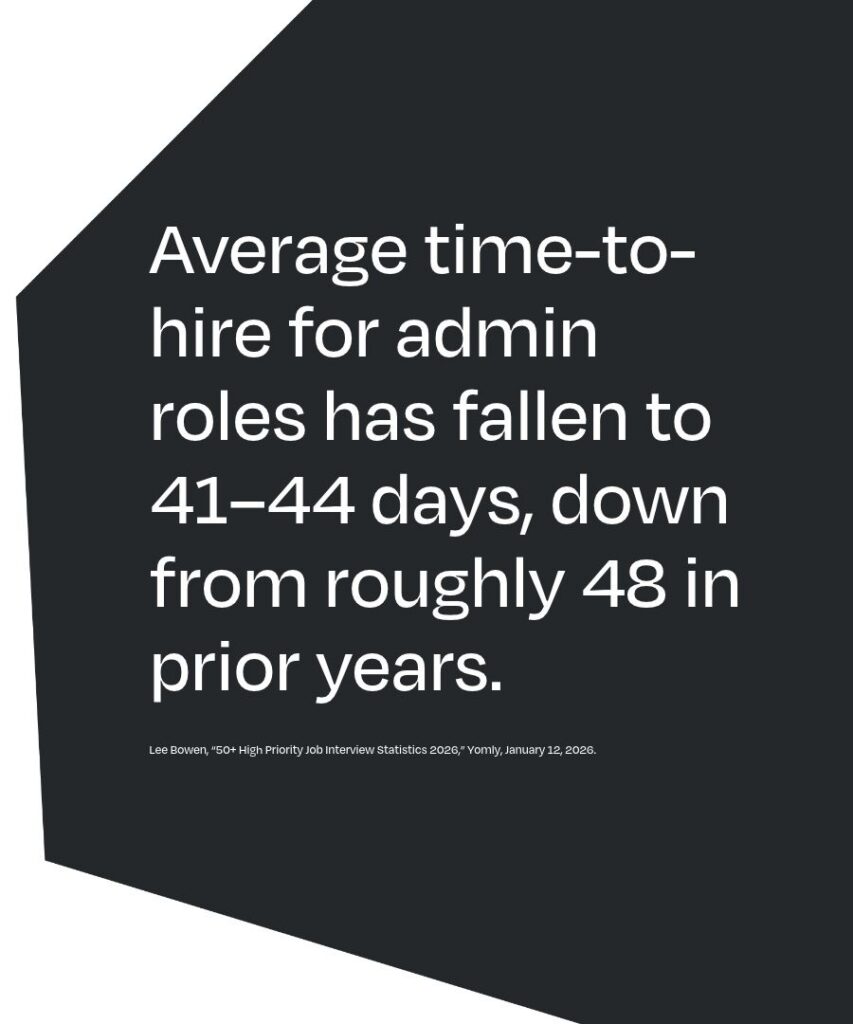
Average time-to-hire for admin roles has fallen to 41–44 days, down from roughly 48 in prior years, as employers reduce approval layers and consolidate interview rounds to compete for talent.6 That improvement tracks with the broader market: SHRM’s 2026 benchmarking data puts the median time-to-fill across non-executive roles at 39 days, down from 44 the year before.7 Still, 60% of companies say their time-to-hire got worse in 2025, and only 12% have managed to shorten it since then.8
Among companies that shortened their process, 36% cut unnecessary interview rounds and 31% tightened the window between interview and offer.9 Employers can stack interviews into fewer, more efficient conversations instead of stretching things across multiple rounds and site visits. Consistency matters as much as speed: 76% of candidates say the speed and quality of a hiring process shapes how they view the employer, and more than half have abandoned a process that dragged on too long.10
A standardized process with clear timelines and transparent communication builds the trust needed to win talent in a market where strong candidates don’t stay unclaimed for long.
Top Administrative Salaries
| AI Specialist | $141,913 |
| AI Integration Specialist | $127,819 |
| Chief of Staff | $121,045 |
| Account Manager | $111,075 |
| Facilities Manager | $96,814 |
| Client Service Associate | $94,084 |
| Logistics Specialist | $91,016 |
| Contracts Administrator | $90,158 |
| Executive Assistant | $88,867 |
| Office Manager | $87,715 |
Contact us today to optimize your workforce strategy and secure the skilled talent your business needs.
For more valuable insights and national averages of salaries across hundreds of roles in administrative, digital marketing, finance, accounting, healthcare, human resources, and information technology, download your complimentary copy today.
- https://www.bls.gov/ooh/office-and-administrative-support/
- https://vault.com/blogs/innovate-with-influence-global-high-tech/ai-proof-jobs-for-2026-careers-and-skills-technology-still-can-t-replace
- https://www.bls.gov/opub/mlr/2026/article/industry-and-occupational-employment-projections-overview.htm
- https://www.gartner.com/en/newsroom/press-releases/2025-12-02-gartner-survey-finds-only-20-percent-of-customer-service-leaders-report-ai-driven-headcount-reduction
- https://www.gartner.com/en/newsroom/press-releases/2026-03-31-gartner-predicts-over-50-percent-of-customer-service-organizations-will-double-their-technology-spend-by-2028
- https://www.yomly.com/job-interview-statistics/
- https://www.shrm.org/topics-tools/research/recruiting-benchmarking
- https://goodtime.io/blog/talent-operations/hiring-statistics/
- https://www.yomly.com/job-interview-statistics/
- www.noon.ai/blog/articles/181-time-to-hire-benchmarks-2026
FAQ
No. The article says administrative roles are evolving, not disappearing. Some repetitive or entry-level data tasks may be automated, but administrative jobs are expected to stay fairly flat through 2034, with openings still coming from retirements and workers leaving the field.
Candidates who combine strong human skills with comfort using AI tools will stand out. Employers value communication, judgment, problem-solving, relationship-building, and the ability to manage complex situations, along with a willingness to learn tools such as Claude, ChatGPT, Microsoft Copilot, Freshdesk, and Help Scout.
AI is taking over more routine ticket handling through chatbots and CRM platforms, which lets customer service professionals focus on more strategic work. Instead of simply closing tickets, they are increasingly expected to understand client history, spot patterns, personalize service, and manage ongoing relationships.
Strong candidates do not stay available for long, so employers with slow or uneven hiring processes risk losing top talent. The article notes that companies are shortening interview cycles, cutting unnecessary rounds, and tightening the time between interview and offer to compete more effectively.
The article lists Administrative Assistant, Executive Assistant, Project Coordinator, Paralegal, Help Desk Support Specialist, and Customer Service Specialist as in-demand roles. It also notes that executive assistants, administrative assistants, HR assistants, and customer service specialists with AI skills may earn a premium.