Addison Group Releases Its 2027 Workforce Planning & Salary Guide

New research in Addison Group’s 2027 Workforce Planning & Salary Guide finds 95% of working and job-seeking Americans say employers could do more to build career confidence, led by clearer paths to advancement and better access to learning and development.
CHICAGO (October 13, 2026) — The American workforce is entering 2027 at an inflection point where AI is moving from experimentation to everyday operations, and employers are placing greater weight on skills and specialized expertise. At the same time, workers are seeking greater clarity on how they can grow and remain valuable as employers’ talent needs evolve rapidly across sectors.
Addison Group, an international business services and human capital technology company, released today its 2027 Workforce Planning & Salary Guide, which examines the trends shaping hiring and workforce strategies in the year ahead. The Guide combines proprietary research, national workforce data, salary figures, and perspectives from across the company’s specialized areas of expertise.
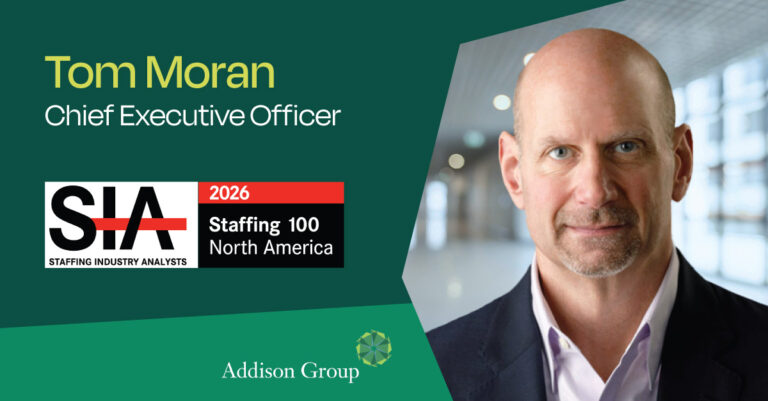
“AI is changing the economics of how companies get work done, but the bigger question for leaders in 2027 is what they do with that change,” said Thomas Moran, CEO of Addison Group. “The greatest opportunity lies in intentionality. As technology takes on more of the work, the organizations that are deliberate about what work stays human, how teams are structured, and which skills will matter most will be best positioned for long-term success.”
This year’s Guide spotlights five key themes shaping the talent market heading into 2027:
1. AI moves from adoption to integration
Across industries, AI is becoming part of everyday workflows. AI-fluent and specialized talent is in demand, while some roles are changing as technology takes on more routine work. At the same time, some jobs once expected to be heavily affected by AI are not shifting as quickly as predicted. Employers will need to determine where technology can augment their teams and where human judgment and expertise remain essential.
2. Skills-first hiring becomes the standard
Skills are playing a bigger role in how employers evaluate talent, with less emphasis on degrees, job titles, and traditional career paths. In fact, 70% of employers already report using skills-based hiring. For employers, that means being clear about the capabilities needed for critical roles. For candidates, it means showing what they can do today as career paths become less linear.
3. Employers navigate “jobless growth”
Organizations continue to invest and recruit, but many are concentrating hiring on critical roles and strategic priorities rather than broad-based headcount growth. AI and productivity gains are allowing some companies to increase output without adding employees at the same pace. That is creating a more selective hiring market, where top candidates can be off the market in as little as 10 days, and employers have less room for drawn-out processes or unclear requirements.
4. Flexible workforce models help fill critical gaps
Talent shortages and changing business needs are pushing employers to look beyond traditional full-time hiring. More organizations are turning to offshoring, fractional talent, and other flexible workforce models to access specialized expertise and address skills gaps. These options can help companies bring in the capabilities they need when a permanent hire is difficult to make or does not fit the business need.
5. The labor market recalibrates
After several years of uncertainty and an extended tug-of-war between employers and candidates, the labor market is moving toward a more balanced footing. Employers are becoming more deliberate about where they hire and which skills they prioritize, while workers are weighing factors beyond compensation. Career development is part of that equation: new research in the Guide finds 95% of workers and jobseekers in the U.S. say there is at least one thing employers could do to increase their confidence about the next five years of their career. Clearer paths to career advancement (65%) and better access to learning and development (63%) top the list.
Addison Group’s 2027 Workforce Planning & Salary Guide provides workforce trends, candidate insights, and salary data across Finance & Accounting, Information Technology, Healthcare, Human Resources, Administrative, Digital Marketing, and Engineering, including role-based and geographic salary ranges for hundreds of positions.
For more, download the 2027 Workforce Planning & Salary Guide here.