Building for What’s Next – 2027 National Hiring & Salary Trends
Excerpt from Addison Group’s 2027 WORKFORCE PLANNING & SALARY GUIDE
Key Takeaways
- The U.S. job market stabilizes in 2027, with AI integration influencing hiring practices and job creation dynamics.
- Employers favor skills-based hiring, with 70% adopting this approach, moving away from degree requirements to focus on AI fluency.
- Jobless growth means companies expand without significant hiring, relying on AI for efficiency while emphasizing competitive salaries for skilled roles.
- Hybrid work is now the preferred arrangement, allowing flexibility to attract top talent while requiring investment in employee satisfaction and training.
- AI screening becomes essential for faster and more effective hiring processes, as employers streamline recruitment to attract high-demand candidates.
Building for What’s Next – 2027 National Hiring & Salary Trends
Here’s Your Playbook for the Year Ahead
After two years of economic turmoil and uncertainty, the U.S. job market is finding its footing. It’s not that inflation, tariffs, and immigration issues have disappeared. But more employers have stopped trying to predict the market and are moving ahead with hiring.
Healthcare, professional and business services, and construction continue to anchor job creation1, while wage growth remains steady, if uneven, with high-skill and specialized workers pulling further ahead. U.S. workers’ optimism on the job market has also risen, aligned with their overall confidence about easing inflation and stock market gains.2
Four forces will define 2027 for employers: artificial intelligence (AI) moving from adoption to full integration into how work gets done, the skills-first focus that is dominating recruiting, the rise of a stopgap workforce as companies lean on offshoring and fractional talent to bridge skills gaps, and a labor market that is recalibrating after several years of employer-candidate tug-of-war. Here’s our take on what’s coming next in 2027.
Steadier Ground, Shifting Rules
Where 2026 was defined by hesitancy, 2027 looks a bit more stable without a return to pre-pandemic levels. Lower U.S. unemployment, strong consumer spending, and solid job growth are helping to fuel positive momentum despite ongoing global conflicts.3
Economists are flagging a new phenomenon called “jobless growth,” where firms expand output using AI and productivity gains rather than adding headcount. The result? The economy needs far fewer net new jobs each month just to hold unemployment steady than it did pre-pandemic.4
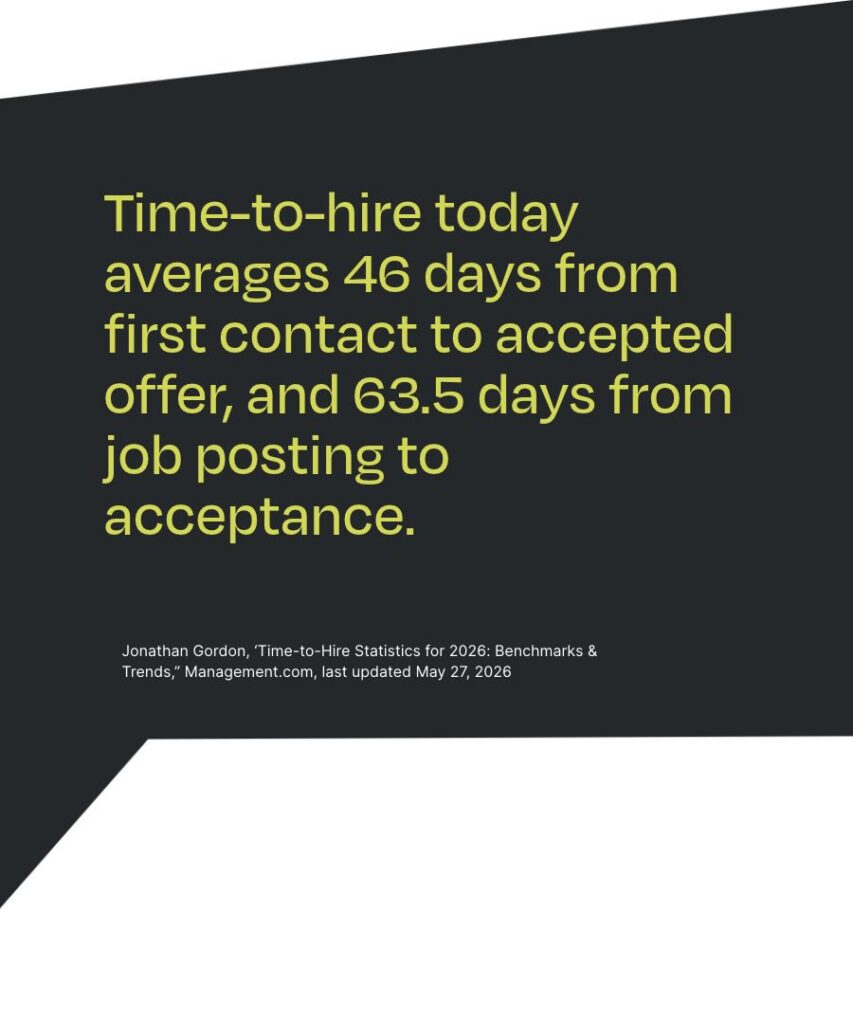
While more employers are recruiting, leaders are prioritizing critical roles and strategic priorities over broad growth, and hiring cycles keep stretching. Time-to-hire today averages 46 days from first contact to accepted offer, and 63.5 days from job posting to acceptance.5 Top candidates, meanwhile, remain available for only about 10 days. The employers who win in 2027 will be the ones who focus on clear job requirements, fewer interview rounds, and fast, transparent decisions.
Wage growth will remain steady at a modest average of 3.4%,6 but is increasingly two-tiered. High-skill, specialized workers with AI expertise will earn a premium, while routine, easily automated roles will see wages flatten. Employers who haven’t already built pay transparency into their processes will be at a disadvantage compared with those who have. SHRM research finds that 65% of organizations listing pay ranges say it makes them more competitive in attracting top talent, and 70% report it’s led to more applicants.
AI Moves from Adoption to Integration
Heading into 2027, AI is evolving from experimentation to full system integration. It is now handling the bulk of customer service resolution at many companies7 and playing a much larger role in early-stage recruiting from screening to first-round interviews.8 Yet some roles where AI was anticipated to take over, like revenue cycle management, are not shifting to AI as quickly as predicted, since evaluating medical claims relies heavily on human judgment.
The World Economic Forum projects roughly 92 million jobs will be displaced by AI globally by 2030, but 170 million new roles will be created in their place. Repetitive data entry and basic customer service jobs face a high risk of automation, while demand surges for workers who can build, manage, or integrate AI systems. Addison Group has found that employers who fund upskilling programs and hire for AI fluency will be well-positioned to compete. In turn, candidates who add AI skills to their expertise will have a clear advantage and can expect to earn a premium wage.9
Related content
- Contract or Permanent Talent: Which to Hire Before Year-End
- The Benefits of Working with a National Staffing Agency
- Cost of Vacancy: Why Businesses Can’t Afford to Delay Hiring
Skills-First is Now the Default
Skills-based hiring has shifted from an experiment to standard practice as we enter 2027. Seventy percent of employers now report using skills-based hiring. The shift away from degree requirements —already at one in four employers — is likely to keep climbing as companies struggle to fill AI- and tech-adjacent roles fast enough.10
Until recently, recruiting and applicant tracking systems had no reliable way to verify skills beyond a candidate’s resume. Now, standardized digital credentials built on emerging systems such as Open Badges 3.0 are giving employers more concrete evidence to screen against, though it remains too early to know how widely AI hiring tools will use them.
The Stopgap Workforce
Talent shortages and early bets on AI that haven’t yet paid off are pushing more companies towards offshoring and fractional talent to solve skills gaps. Some companies jumped the gun on AI, cutting jobs based on what the technology was expected to handle rather than what it could actually do yet. Today, 55% of companies that have already automated jobs regret the move, and many are looking to offshoring and outsourcing to gain AI skills at a lower cost.11
Fractional leadership is also enabling companies to access senior executives in a more flexible, cost-efficient way. Thanks to the rise in AI tools, experienced leaders can hit the ground running during a specific growth phase or step in to set up technical architecture and lead digital transformation.12 Technology, IT consulting, financial services, and accounting are benefiting from this trend, with the global IT services outsourcing market projected to reach $1.2 trillion by 2030, growing at roughly 8.6% annually.13
“More executives see offshoring as both a cost saver and a stopgap, bridging where they are today with full AI adoption down the road.” -Ed Meindl, Senior Vice President, International Operations, Addison Group
Market Recalibrates
After several years of leverage swinging first one way, then the other, 2027 settles into something closer to equilibrium. Return-to-office mandates that once triggered mass resignations barely register anymore, with only 7% of employees now saying they’d quit over a mandatory RTO policy.14 Hybrid has emerged as the dominant arrangement across most industries, though pockets of the market continue to lean remote. This is especially true in non-clinical healthcare and contract finance and accounting roles, where employers are drawing from deeper, more specialized talent pools by staying flexible on location.
That flexibility is a competitive tool, not a concession, and it only works if employers back it up elsewhere. Recruiting and retaining top performers still requires a real investment in company brand, training, competitive salary and benefits, and work-life balance. Six out of 10 employees with remote-capable jobs say they want a hybrid work arrangement, and 52% are currently working in that environment.15 Candidates, for their part, need to build skills-based resumes to demonstrate real-world problem-solving and show a deep passion for learning.
In a year shaped by AI integration, skills-first hiring, and a recalibrating market, the winners in 2027 will be employers and candidates who adapt fastest.
Contact us today to optimize your workforce strategy and secure the skilled talent your business needs.
For more valuable insights and national averages of salaries across hundreds of roles in administrative, digital marketing, finance, accounting, healthcare, human resources, and information technology, download your complimentary copy today.
- https://www.bls.gov/news.release/pdf/ecopro.pdf
- https://www.staffingindustry.com/news/global-daily-news/us-consumers-more-optimistic-on-jobs-inflation-in-ny-fed-survey
- https://www.nytimes.com/live/2026/07/02/business/jobs-report-economy
- https://fortune.com/2026/04/06/ai-tech-displacement-effect-gen-z-16000-jobs-per-month/
- https://management.org/time-to-hire-statistics
- https://www.shrm.org/topics-tools/news/benefits-compensation/2027-pay-salary-raises-employers-decline-slightly
- https://newsroom.cisco.com/c/r/newsroom/en/us/a/y2025/m05/agentic-ai-poised-to-handle-68-of-customer-service-and-support-interactions-by-2028.html
- https://fortune.com/2026/05/04/4-in-10-job-candidates-bailed-hiring-rounds-required-ai-interview/
- https://www.pwc.com/gx/en/news-room/press-releases/2025/ai-linked-to-a-fourfold-increase-in-productivity-growth.html
- https://www.hrdive.com/news/employer-eliminate-degree-requirements-2025/748998/
- https://www.itpro.com/business/business-strategy/analysts-warn-ai-layoffs-could-spark-a-new-wave-of-offshoring-enterprises-are-rehiring-after-workforce-cuts-but-either-outsourcing-or-at-lower-rates-of-pay
- https://www.techloy.com/the-c-suite-is-going-fractional-how-companies-cut-executive-costs-without-losing-leadership/
- https://www.grandviewresearch.com/press-release/global-it-services-outsourcing-market
- https://www.hrdive.com/news/workers-would-not-quit-over-mandatory-rto/809979/
- https://www.gallup.com/401384/indicator-hybrid-work.aspx#ite-510881
FAQ
It means companies can grow output with AI and better productivity without hiring as many new workers as before. For employers, that makes hiring more selective and raises the value of critical roles, strategy, and skills that support growth, automation, and AI use.
AI is moving from test projects into day-to-day use across business operations. This includes customer service, recruiting, productivity tools, and technical systems. As routine work becomes more automated, demand is rising for people who can build, manage, judge, or connect AI systems. Candidates with AI fluency should have an edge and may earn more, while employers that invest in upskilling will be better able to compete.
Employers should move faster and make hiring easier to navigate. The text notes that time-to-hire averages 46 days from first contact to accepted offer. Top candidates may only be available for about 10 days. Clear job needs, fewer interview rounds, transparent pay ranges, and faster decisions can help employers compete for high-demand talent.
Skills-based hiring is becoming standard. This is because employers need faster, more practical ways to spot qualified talent, especially for AI and tech-adjacent roles. With 70% of employers using skills-based hiring and more companies dropping degree requirements, resumes alone are no longer enough. Digital credentials, such as Open Badges 3.0, can help employers verify skills more clearly.
Hybrid work is now the dominant setup across many industries and is more of a competitive tool than a compromise. While fewer employees say they would quit over return-to-office rules, many remote-capable workers still want a hybrid setup. Employers that pair flexibility with strong pay, benefits, training, brand, and work-life balance will be better at attracting and keeping top performers.