Compounding Interest in AI: Why Finance & Accounting’s AI Ambitions Are Outpacing Readiness

AI in Finance and Accounting: Adoption Is Outpacing Readiness
Every finance and accounting leader has heard the pitch: AI will close the books faster, catch the anomalies humans miss, and free your team for higher-value work. Fewer have gotten there.
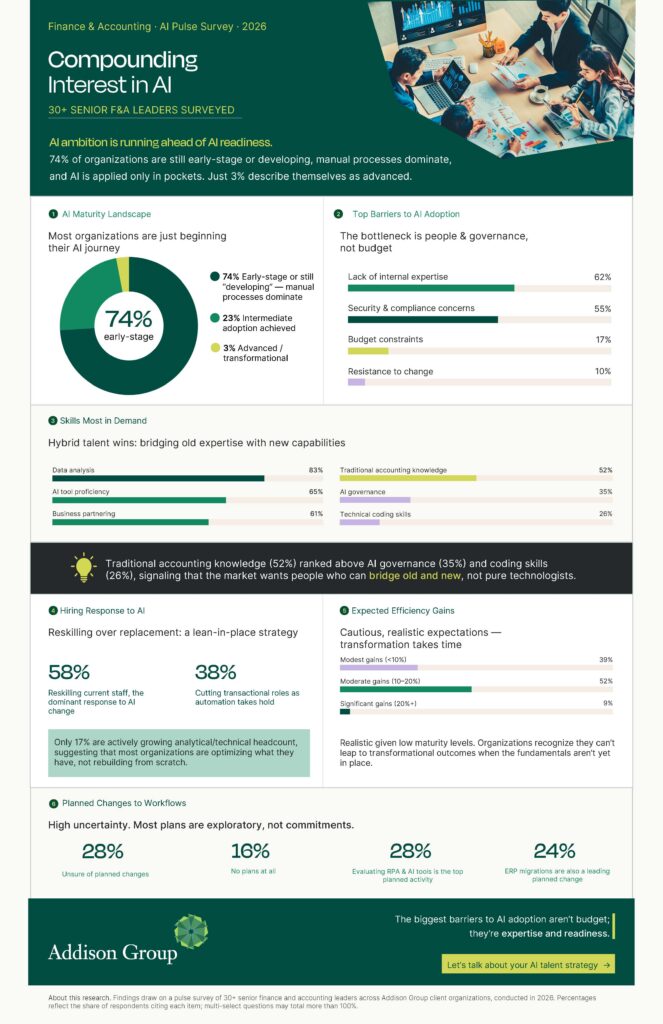
Addison Group’s AI Pulse Survey1 sought perspectives from approximately 30 senior finance and accounting (F&A) leaders at some of our top client organizations — leaders with a firsthand view of how AI adoption is progressing within their organizations. Their responses reveal a significant gap between AI ambition and readiness: 74% of these organizations describe themselves as early-stage or still developing, with manual processes still doing most of the work. Only 3% call themselves advanced or transformational. The ambition is real. The infrastructure to support it, for most teams, isn’t yet.
That gap isn’t unique to any one company; instead, it shows up across the broader market too. A recent industry roundup of 2026 accounting AI research found the same disconnect at scale: Deloitte’s Finance Trends survey2 found 63% of finance departments have deployed some form of AI, but only 21% report clear, measurable value and just 14% have fully integrated AI agents into daily operations, which is a gap Deloitte itself attributes to the difficulty of moving from pilots to real embedded use. Separate CFO-focused research (RGP, surveying 200 U.S. CFOs3) found only 14% of finance leaders have seen a clear, measurable AI return so far.
The Bottleneck Isn’t Budget. It’s People and Governance
If you assumed cost was the biggest obstacle to AI adoption, the survey says otherwise. Only 17% of respondents cited budget constraints as a top barrier. The real friction points were lack of internal expertise (62%) and security and compliance concerns (55%) — more than three times as many leaders pointed to skills and governance gaps as pointed to cost.
That tracks with what’s playing out industry wide. Research on 2026 banking AI programs4 found that while nearly every institution surveyed had adopted some form of AI, most of that adoption was still limited to pilots or vendor-embedded tools; only a small fraction had moved proofs of concept into a scaled, governed production program. The pattern is consistent: organizations can turn AI on. Turning it into something governed, secure, and trusted enough to run core financial processes is much harder and slower.
The Skills Market Wants Bridges, Not Just Technologists
Here’s where the survey gets genuinely interesting for anyone building a finance team right now. When asked which skills are most in demand, F&A leaders ranked:
- Data analysis — 83%
- AI tool proficiency — 65%
- Business partnering — 61%
- Traditional accounting knowledge — 52%
- AI governance — 35%
- Technical coding skills — 26%
Traditional accounting knowledge outranked both AI governance and coding skills. In other words, the market isn’t primarily hunting for machine learning engineers to embed in the finance function but rather people who understand the business of accounting well enough to know where AI adds value, and where it introduces risk. Hybrid talent, not pure technologists, is winning the hiring conversation.
This is consistent with a broader industry finding from Thomson Reuters Institute’s Future of Professionals Report:5 firms with a defined AI strategy are roughly twice as likely to report AI-driven revenue growth as those without one. Strategy and judgment, the “bridge” skills, appear to matter as much as the technology itself.
Reskilling, Not Replacement — For Now
Faced with AI-driven change, 58% of F&A leaders said their organization’s primary response is reskilling current staff. Only 38% are cutting transactional roles as automation takes hold, and a mere 17% are actively growing analytical or technical headcount. The clear read: most organizations are optimizing the team they already have, not staffing up from scratch or downsizing aggressively.
That “lean-in-place” strategy is a rational response to where maturity currently sits. It’s hard to justify a hiring spree or a significant cut when 74% of your peers are still early-stage.
Expectations Are Modest, and That’s Probably Healthy
Only 9% of respondents expect significant efficiency gains (20%+) from AI in the near term. The majority (52%) expect moderate gains of 10-20%, and 39% expect modest gains under 10%.
That caution looks well-founded next to outside benchmarks. A joint Stanford/MIT study6 of 277 accountants across 79 firms, published via the Journal of Accountancy, found meaningful but incremental improvements from AI adoption: close cycles shortened by roughly 7.5 days, and accountants shifted about 8.5% of their time away from routine work toward higher-value tasks. Real, but not transformational, which is exactly the range Addison Group’s respondents say they expect. Separately, Grant Thornton’s 2026 AI Impact Survey7 found that organizations with fully integrated AI were far more likely to report revenue growth than those still piloting it, which serves as a reminder that the payoff tends to show up only after teams move past the early stages most are still in.
Workflow Plans: More Questions Than Commitments
Nearly half of respondents (28% unsure, 16% with no plans at all) don’t have a firm view on how their workflows will change. Among those with a direction, evaluating RPA and AI tools ranks as the top planned activity, with ERP migrations close behind, which is a notable signal, since ERP projects are exactly where AI ambitions and workforce readiness collide most directly. A modern ERP is often the infrastructure that makes AI-driven finance possible in the first place, but ERP projects are also notoriously resource-intensive undertakings that can pull internal teams away from their day jobs at exactly the moment leaders are trying to build AI capability. Even the organizations with a plan are still largely in the evaluation phase, not the execution phase.
What This Means for F&A Leaders
Put together, the data tells a consistent story: AI adoption in finance and accounting isn’t stalling because of budget, and it isn’t being driven by a race to automate people out of jobs. It’s being gated by expertise and governance — the ability to deploy AI responsibly, with the right controls, and the right people who understand both the technology and the function it’s meant to serve.
For leaders building their 2026-2027 talent strategy, that suggests a specific kind of hire: not a pure data scientist, and not a traditional accountant standing still, but someone who can do both. The organizations that find that hybrid talent first will be the ones positioned to move from “early-stage” to “advanced” while their peers are still evaluating pilots.
How Addison Group Helps You Close the Readiness Gap
Closing the gap between AI ambition and AI readiness isn’t just a hiring question; it’s a talent strategy question. Addison Group works with F&A leaders to:
- Source hybrid talent — professionals who combine traditional finance and accounting expertise with AI tool proficiency and data analysis skills, the exact profile organizations need to move from “early-stage” to “advanced.”
- Identify business-partnering skill sets — candidates who can translate between finance and technology teams.
- Fill critical skills gaps — targeted placement for the capabilities leaders say are hardest to find internally, including data analysis and AI tool proficiency.
- Support ERP migrations and implementations — the second most-cited planned workflow activity in this survey. Whether you’re in early planning or mid-implementation, Addison Group provides experienced contract professionals who can bridge talent gaps during ERP/CRM/HCM projects without pulling your core finance team off their daily responsibilities.
- Enable “lean-in-place” hiring — flexible and permanent placement options that complement the reskilling strategies that leaders are already pursuing, adding targeted talent rather than requiring a costly rebuild.
Ready to close your own AI readiness gap? Let’s talk about your AI talent strategy.
Download the AI Pulse Survey infographic for the complete results.
Sources
- Addison Group, 2026 AI Pulse Survey (30+ senior finance and accounting leaders) — the infographic and proprietary data this article is based on.
- Deloitte, Finance Trends 2026: Navigating the Expanded Scope of Finance (1,326 global finance leaders).
- RGP, The AI Foundational Divide: From Ambition to Readiness (200 U.S. CFOs).
- Wolf & Company, 2026 AI Adoption & Maturity in Banking Survey.
- Thomson Reuters Institute, Future of Professionals Report 2025 (2,275 professionals across legal, risk, compliance, tax, accounting, audit, and global trade).
- MIT Sloan / Stanford Graduate School of Business, How Generative AI Can Make Accountants More Productive (277 accountants across 79 firms; also covered in the Journal of Accountancy, August 2025).
- Grant Thornton, 2026 AI Impact Survey (950 business leaders).