National hiring & employment trends: 2026 Workforce Planning Guide

With inflation, consumer costs, tariffs, and immigration policies shaping the landscape, the U.S. job market has entered a slower phase of job creation.1 Many organizations are approaching growth more cautiously, creating a period of careful decision-making for both employers and candidates. Yet, there are bright spots: healthcare and construction continue to grow, entrepreneurs and small businesses are driving local innovation, and steady consumer spending is supporting industries such as retail, logistics, and hospitality. Experts also point to potential tax cuts, easing interest rates, and rising wages in technology and customer service as positive signals.2 These mixed signals highlight the paradox of today’s market: overall growth is cooling, but demand for specialized talent remains hot.
Looking ahead, a mix of economic uncertainty, rapid adoption of artificial intelligence (AI), and shifting worker demographics will shape the labor market in 2026. To stay competitive, employers must adapt quickly and rethink how they attract and retain talent in this fast-changing environment.
Summary
The 2026 U.S. labor market is cooling amid inflation, policy shifts, geopolitics, and slower growth, prompting cautious hiring even as demand for specialized talent remains strong. Bright spots include healthcare and construction, small-business innovation, and consumer-supported sectors, with potential tailwinds from easing rates, tax changes, and rising wages. Employers that win will move fast with skills-first hiring, pay transparency, clear requirements, and streamlined interviews—paired with competitive rewards, hybrid flexibility, and strategies tailored to a four-generation workforce. Rapid AI adoption is widening skills gaps and boosting pay premiums for AI expertise, making upskilling, certifications, and continuous learning essential for organizations and workers.
Slower growth, strategic opportunities
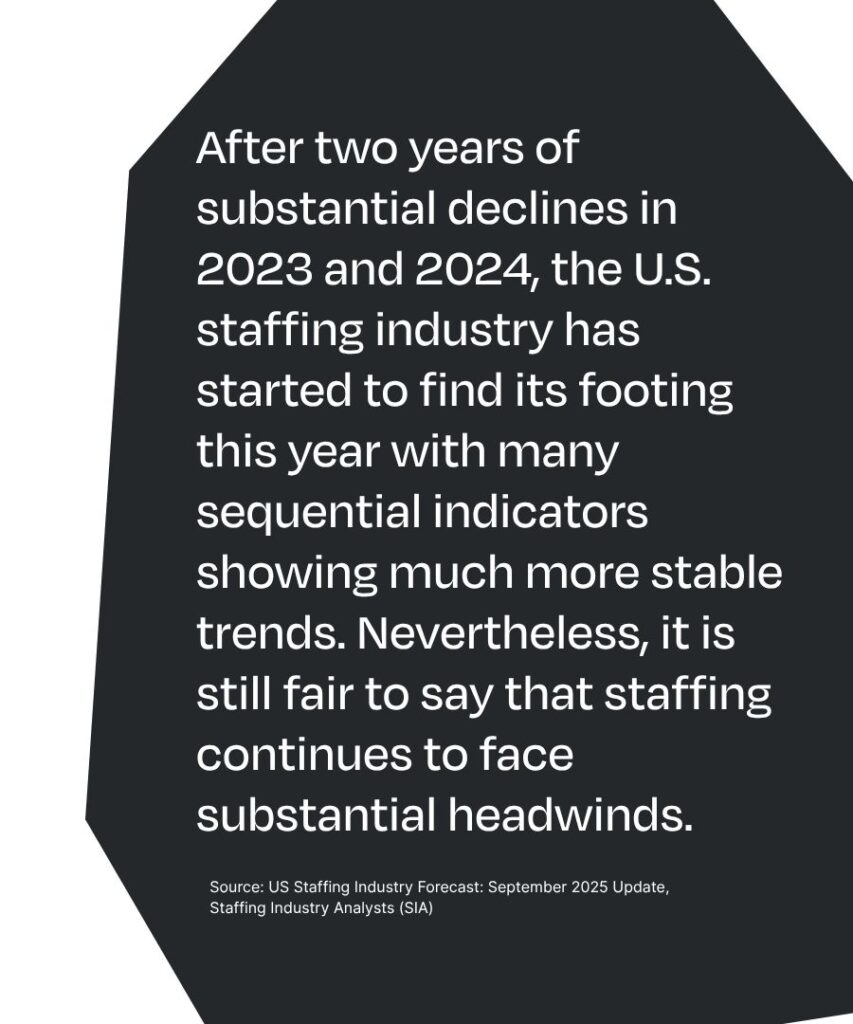
After a sluggish year of hiring thus far in 2025, the 2026 job market faces continued headwinds. Persistent inflation, geopolitical tensions, evolving regulations, and slower economic expansion are fueling uncertainty for both employers and candidates.
Wages grew 3.9% in 2025, slightly below the 4.5% increase seen in 2024 but still above pre-pandemic levels.3 While there are fewer job postings overall, competition for top-tier talent remains fierce, particularly in healthcare and engineering, where aging populations are driving steady demand.4
Immigration policy changes are also shaping key sectors, including construction, healthcare, technology, and professional services, by affecting the pipeline of both highly skilled talent and essential frontline workers.5 In this environment, employers can gain an edge by being more transparent about pay ranges early in the hiring process, helping to attract qualified candidates and avoid costly misunderstandings later.6
“Compensation conversations can’t be left to guesswork as employees want clarity and employers who are more upfront about pay are more successful in hiring.”
Stacy Snider, Sr. Vice President, Finance & Accounting Executive Search, Addison Group
At the same time, 73% of U.S. workers plan to stay in their current roles, prioritizing flexibility, culture, and compensation rather than taking risks on new opportunities.7 This creates a smaller pool of passive candidates who will only consider positions they view as truly transformative, making it essential for employers to act strategically. By defining clear job requirements, streamlining interviews, and communicating openly about compensation and culture, organizations can turn market challenges into opportunities to secure top talent.
Addison Group has found that time-to-hire has stretched from 36 to 44 days, yet top candidates are typically available for only 10 days.8 Keeping jobs vacant for too long isn’t just frustrating — it represents significant lost productivity and revenue for the company. Employers that define clear job requirements early, streamline interview rounds, and communicate openly about pay and culture will have an advantage in securing top talent.
Four generations, one workforce
While the overall market faces headwinds, demographic shifts are simultaneously reshaping the workforce. For the first time, four generations – Baby Boomers, Generation X, Millennials, and Generation Z – are working side by side. Each group approaches work differently, from collaboration styles to technology preferences, requiring flexibility and a tailored approach to recruitment and retention.
By 2030, Millennials and Gen Z are expected to make up nearly 74% of the U.S. workforce.9 Millennials, born between 1981 and 1996, are digital natives who balance traditional work styles with an openness to new technology, often valuing collaboration and teamwork. Gen Z, born between 1997 and 2012, are fueling today’s tech transformation and seeking meaningful work, individual achievement, and entrepreneurial opportunities. Both groups tend to favor hybrid work environments, though Millennials often prefer more structure while Gen Z values flexibility.10
Companies that invest in understanding generational differences and building inclusive strategies will better unite these diverse groups productively.
Skills-first hiring takes off
Amid talent shortages and economic uncertainty, employers are shifting away from traditional degree requirements and job titles toward skills-based hiring.9 This trend is particularly strong in finance and technology, where AI and automation are transforming job roles.10 One in four companies has already removed degree requirements for certain positions, broadening the applicant pool, improving diversity, and allowing greater flexibility in setting compensation.11
While this approach widens access to talent, it requires companies to strengthen their evaluation methods. Employers must be able to accurately assess technical and soft skills, while also investing in training programs to close skill gaps and prepare employees for the evolving workplace.
Finding balance in a tight market
Although hiring has slowed, top candidates remain highly sought after, making today’s labor market a balancing act. Employers may have more choice given fewer job openings, but retaining and attracting top performers still requires competitive compensation, strong benefits, and an authentic, supportive work culture.
To stay competitive, employers will need to clearly define their employer value proposition, offer attractive compensation and benefits, and create a seamless, positive recruiting experience. Workplace flexibility remains a critical factor—roughly half of U.S. employees now expect at least a hybrid schedule, even as more companies push for a full return to the office. Organizations that fail to meet these expectations risk disengagement, lower retention, and higher turnover.
At the same time, candidates are recalibrating their strategies. Many are emphasizing skills-based resumes and positioning themselves as adaptable generalists who can add value across different functions. This shift is increasing their attractiveness to employers seeking versatile, future-ready talent.
AI transformation
If last year marked the tip of the AI iceberg, 2026 is the year its full scale becomes visible. AI is now deeply embedded in everyday life, from healthcare devices to autonomous vehicles, and its influence on the job market is undeniable.
Today, 78% of businesses report using AI, up from 55% just a year earlier, with many citing productivity gains and narrower skills gaps as key benefits.12 Workers with AI expertise can now command salaries up to 56% higher than peers, more than double the premium from the year before.13 Industries such as healthcare, manufacturing, finance, and retail are seeing the most rapid AI-driven growth.14
However, the supply of skilled professionals remains insufficient to meet demand. Employers need to look beyond degrees and focus on certifications and real-world experience, while also investing in upskilling programs. For workers, continual learning and adaptability will be critical to thriving in an AI-driven economy.
The organizations and candidates who embrace this transformation by building skills, investing in training, and quickly adopting new technologies will stay ahead in 2026 and beyond.
Q&A
Question: What defines the 2026 U.S. labor market, and where are the bright spots?
Short answer: The market is cooling due to lingering inflation, tariffs, immigration shifts, geopolitical tensions, and slower economic growth, prompting cautious hiring. Still, demand for specialized talent remains strong. Healthcare and construction continue to expand; entrepreneurs and small businesses are fueling local innovation; and steady consumer spending supports retail, logistics, and hospitality. Potential tailwinds such as tax cuts, easing interest rates, and rising wages in tech and customer service – add upside. The paradox: overall growth is slower, yet competition for high-skill talent is intense. These patterns align with national hiring trends and broader employment trends.
Question: How can employers secure top candidates when hiring has slowed?
Short answer: Win on speed, clarity, and transparency. Time-to-hire has stretched to 36-44 days, but top candidates are typically off the market in about 10 days. Define must-have skills early, streamline interview rounds, and be upfront about pay and culture to avoid mismatches. With 73% of workers planning to stay put, the passive candidate pool is selective—an attractive employer value proposition, competitive total rewards, and flexible (often hybrid) work options are key.
Question: How do generational shifts affect workforce strategy?
Short answer: Four generations—Boomers, Gen X, Millennials, and Gen Z—now work side by side, requiring flexible, inclusive approaches. By 2030, Millennials and Gen Z are expected to comprise about 74% of the workforce. Millennials often value collaboration and more structure, while Gen Z prioritizes meaningful work, individual achievement, and entrepreneurial opportunities. Both generally favor hybrid work. Companies that tailor communication, development, and flexibility to these differences will better attract and retain talent.
Question: Why is skills-first hiring gaining momentum, and what does it require?
Short answer: Talent shortages and evolving roles — especially in finance and tech as AI/automation reshape work — are pushing employers to prioritize capabilities over degrees and titles. One in four companies has removed degree requirements for some roles, broadening applicant pools, improving diversity, and enabling compensation flexibility. To succeed, employers must strengthen skills assessments (technical and soft), use practical evaluations, and invest in training and upskilling to close gaps.
Question: How is AI changing pay and demand, and how should employers and workers respond?
Short answer: AI adoption has surged to 78% of businesses (up from 55% a year earlier). Professionals with AI skills can earn up to 56% higher salaries, with rapid growth in healthcare, manufacturing, finance, and retail. Supply of AI-proficient talent lags demand, so employers should look beyond degrees to certifications and real-world experience, while funding upskilling programs. Workers should commit to continual learning and adaptability to thrive in an AI-driven economy.
For valuable insights and national averages of salaries across hundreds of roles in administrative, digital marketing, finance, accounting, healthcare, human resources, and information technology, download your free copy today.
- https://finance.yahoo.com/news/us-job-market-may-running-090042829.html?guccounter=1&guce_referrer=aHR0cHM6Ly93d3cuZ29vZ2xlLmNvbS8&guce_referrer_sig=AQAAANPRCH1DtKjQq–hVrOJFPWamQcDzsAw_MTm23TOYyMKtuj-CHLyG0n_jrQmE71wT1lVC9pRlsijXFqgzKtN199c47f6e9MqP3zlz7BpsOPO0fCd_MgxVE-3BLve-B_hW-V14NxYCa0lSSu1udj_9uxyhYf0vJRveg5UNRM2TiI_
- https://www.usnews.com/news/slideshows/5-bright-spots-in-the-us-economy
- https://money.usnews.com/careers/articles/how-much-will-salaries-increase#:~:text=Amid%20a%20tight%20labor%20market,Jobs%20That%20Pay%20$100K.
- https://www.cnbc.com/2025/08/05/official-jobs-numbers-show-its-a-bad-time-to-be-looking-for-workunless-youre-in-this-field.html
- https://thehill.com/lobbying/5348916-trump-immigration-restrictions-impact/#:~:text=Reflecting%20the%20concerns%20of%20the,the%20leisure%20and%20hospitality%20industry.
- https://www.staffingindustry.com/news/global-daily-news/is-pay-transparency-the-new-norm
- https://www.staffingindustry.com/news/global-daily-news/73-of-us-workers-plan-to-stay-in-jobs
- Addison Group, 2025
- https://investor.workday.com/2025-03-05-Talent-Shortage-Concerns-Drive-Shift-to-Skills-Based-Strategies,-Workday-Research-Finds
- https://www.webpronews.com/2025-hiring-shift-skills-first-ai-enabled-models-lead-the-way/
- https://www.hrdive.com/news/employer-eliminate-degree-requirements-2025/748998/#:~:text=In%20the%20survey%20of%201%2C000%20hiring%20managers%2C,and%20the%20ability%20to%20offer%20lower%20salaries.
- https://hai.stanford.edu/ai-index/2025-ai-index-report
- https://www.google.com/search?q=pwc+analysis+on+how+AI+skills+impact+salary&rlz=1C5GCEM_enUS1155US1155&oq=pwc+analysis+on+how+AI+skills+impact+salary&gs_lcrp=EgZjaHJvbWUyBggAEEUYOTIHCAEQIRigATIHCAIQIRigATIHCAMQIRigAdIBCTEzNDcwajBqN6gCALACAA&sourceid=chrome&ie=UTF-8
- https://binmile.com/blog/ai-business-trends-of-top-industries/